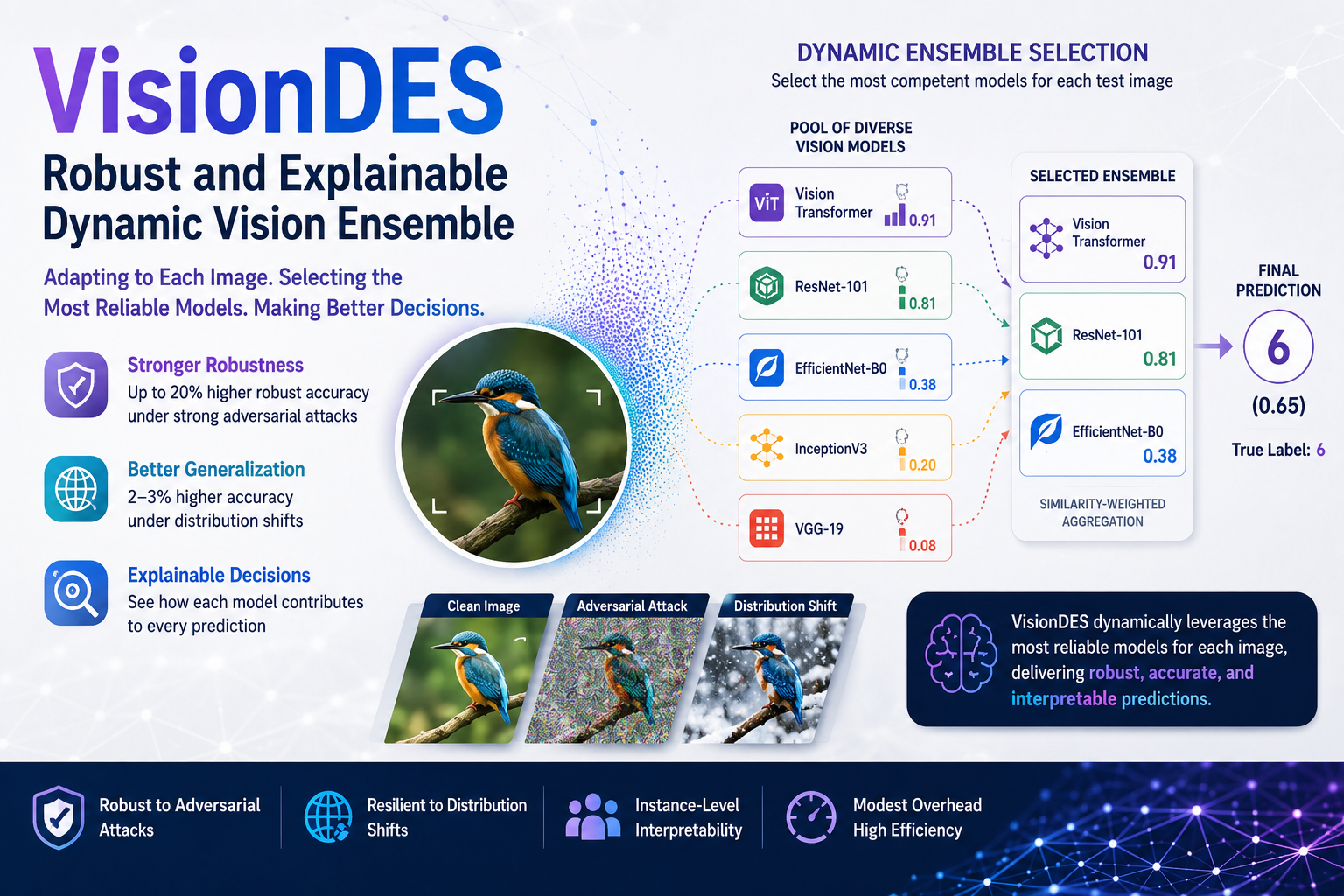
May 17, 2026
9 min read
VisionDES: Robust and Explainable Dynamic Vision Ensemble
**Key innovation:** VisionDES uses DINO-based ViT embeddings and FAISS approximate nearest-neighbor search to construct a local Region of Competence in embedding space for each test sample — then dynamically selects and weights classifiers based on both their local accuracy and feature-space consistency.### Three Stages**Stage 1 — Training**Diverse vision models (ViT, ResNet, EfficientNet, VGG, etc.) are trained. DINO embeddings of a validation set (DSEL) are indexed in a FAISS store for fast retrieval.**Stage 2 — Selection**For each test image, its DINO embedding is computed and *k*=7 nearest neighbors are retrieved, defining the RoC. Classifiers are scored by their accuracy within that region using one of three selection rules:- **KNORA-U**: includes any classifier that correctly labels at least one RoC sample, weighted by competence score.- **KNORA-E**: the stricter rule — only classifiers that correctly label *all* RoC samples are selected.- **FIRE**: handles indecision regions near class boundaries by requiring correct predictions from each class present in the RoC.**Stage 3 — Aggregation**Selected classifiers are combined via similarity-weighted voting. Models whose internal representations diverge from the RoC mean are automatically down-weighted.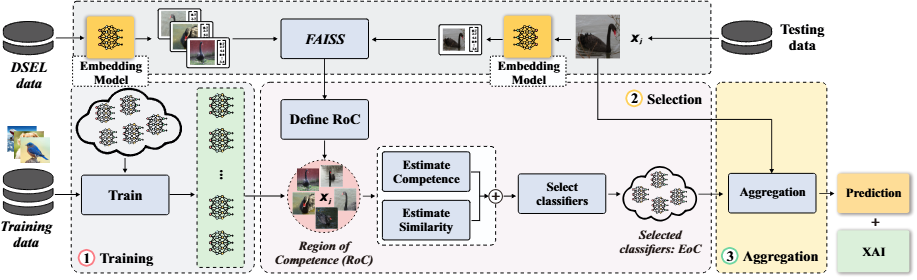**Figure 2.** The VisionDES framework. At test time, the input image's DINO embedding is used to retrieve a Region of Competence from the DSEL store. Competence and similarity scores are jointly computed and fused to produce the final weighted prediction.---## Similarity-Weighted CompetenceThe most distinctive technical contribution of VisionDES is the **similarity-weighted competence mechanism**. Classical DES methods assign weights based solely on a classifier's accuracy within the RoC. VisionDES adds a second signal: *feature-space consistency*.For each classifier `c_i`, VisionDES computes the cosine similarity between the mean embedding of RoC samples (as seen through `c_i`'s penultimate layer) and the embedding of the test image itself. When a model has been adversarially perturbed, its internal representations become misaligned with those of clean neighboring samples — its similarity score drops, and so does its contribution.The competence and similarity scores are fused via a convex combination:```textw_i(t) = α_t · comp_i(t) + (1 − α_t) · s_i(t)```The mixing coefficient `α` is estimated *adaptively* per test sample, based on the relative variability of each signal across the ensemble. This lets similarity dominate when it provides a strong discriminative signal, while falling back to competence when similarity scores are homogeneous.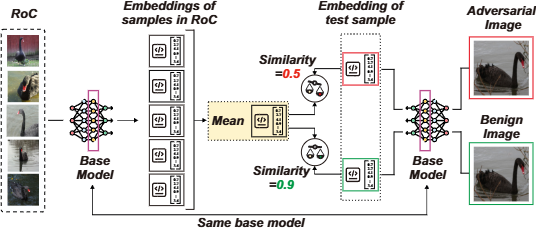**Figure 3.** Similarity-weighted aggregation. For a benign image, a model's internal representation closely matches the RoC mean — similarity ≈ 0.9. For an adversarially perturbed input, the same model's representation drifts away — similarity drops to ≈ 0.5 — automatically reducing its weight in the ensemble decision.---## Instance-Level InterpretabilityBeyond robustness, VisionDES is **inherently interpretable**. Because classifier selection is explicit and per-sample, the framework reports — for any given prediction — exactly:- Which models were selected- Each model's competence score and feature similarity score- Each model's assigned weight- Each model's top-5 class predictionsThe Region of Competence is also visualized: the nearest validation samples are shown alongside their L2 distances to the test image, giving a concrete picture of the neighborhood in which the decision was made.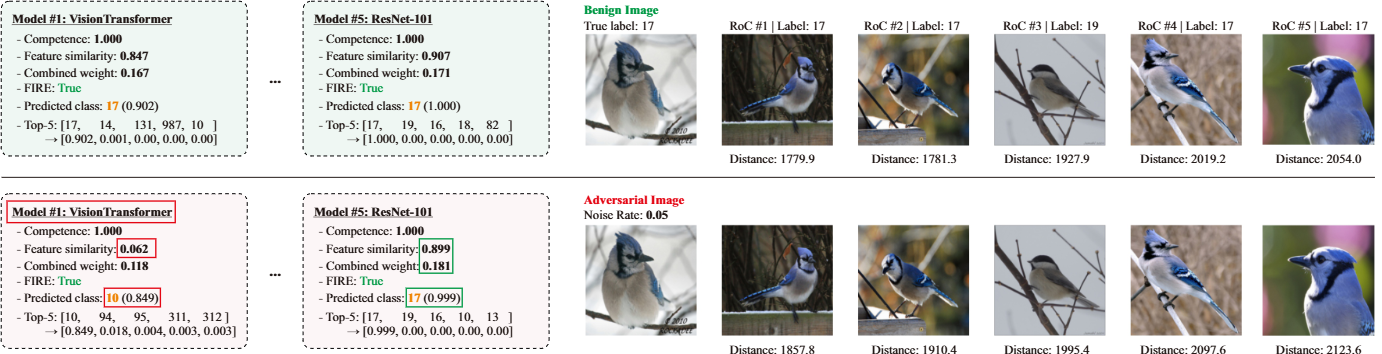**Figure 4.** Interpretability output for a test image under benign conditions (top) and under a PGD adversarial attack on the ViT model (bottom). Under attack, the ViT's feature similarity collapses from 0.847 to 0.062 — its combined weight is automatically reduced. Unattacked models maintain stable similarity and correct predictions. The RoC structure is largely preserved thanks to DINO's robustness.---## Experimental ResultsVisionDES is evaluated across three settings — clean conditions, adversarial attacks, and distribution shift — on ImageNet, CIFAR-10, CIFAR-100, and three MedMNIST datasets (RetinaMNIST, BloodMNIST, DermaMNIST).### Clean PerformanceUnder standard conditions, VisionDES consistently matches or outperforms soft voting, hard voting, stacking, and DUS across all benchmarks. Notably, while soft and hard voting *degrade* when weaker models are added to the pool, VisionDES continues to improve — rising to **81.25%** on ImageNet with six models, up from 80.95% with three. VisionDES can identify and down-weight weaker classifiers per-sample, rather than blending them in unconditionally.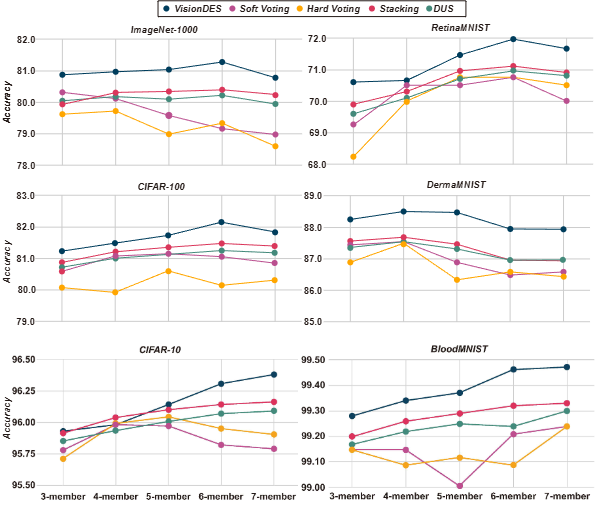**Figure 5.** Accuracy as a function of ensemble pool size under clean conditions on ImageNet-1000, CIFAR-100, RetinaMNIST, and DermaMNIST. VisionDES consistently outperforms static methods and DUS, and uniquely continues to improve as weaker models are added.### Adversarial RobustnessWe stress-test VisionDES with ensemble adversarial attacks, increasing the fraction of attacked base models from 1/6 to 6/6. When **83.3% of models are under PGD attack** on ImageNet:| Method | Accuracy ||---|---|| **VisionDES** | **51.72%** || DUS | 39.45% || Hard Voting | 37.08% || Stacking | 33.53% || Soft Voting | 26.24% |VisionDES also holds up across all four attack strategies. Under the **C&W attack** with all models targeted, VisionDES achieves **81.55% accuracy** vs. 59.0% (soft), 61.9% (hard), 61.15% (stacking), and 64.8% (DUS) — an advantage exceeding 16 percentage points.Attack order also matters: targeting stronger models first produces more transferable adversarial examples, strongly impacting static ensembles. VisionDES remains stable across both orderings, confirming that dynamic selection and similarity-weighted aggregation mitigate transferability effects.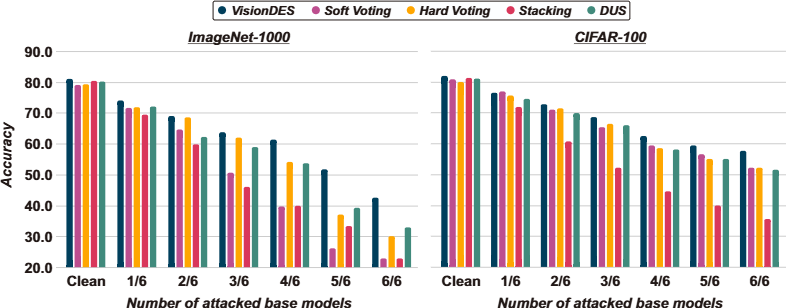**Figure 6.** Ensemble robustness under PGD attack (ε=0.05 for ImageNet, ε=8/255 for CIFAR-100), with the number of attacked base models increasing from 1/6 to 6/6. VisionDES maintains a significantly higher accuracy floor as more models are compromised.### Increasing Perturbation BudgetAs the adversarial budget grows, the performance gap widens. At **ε=0.031**, VisionDES maintains accuracy gains exceeding 13% over static ensembles. At **ε=0.05** with half the pool attacked, VisionDES achieves over **20% higher accuracy** than both static methods and DUS.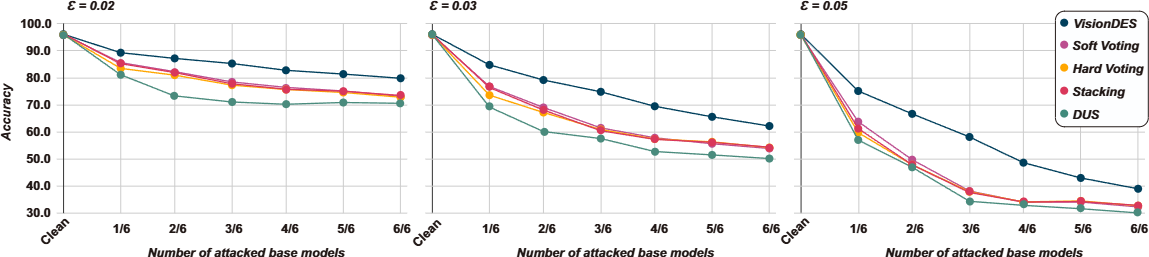**Figure 8.** Ensemble accuracy on CIFAR-10 under PGD with ε ∈ {0.02, 0.031 (8/255), 0.05}, attacking models strongest-to-weakest. The advantage of VisionDES widens with both higher perturbation budget and more models attacked.### Distribution ShiftUnder natural distribution shift (CIFAR-10 → CIFAR-10.1), the accuracy drop for VisionDES with seven models is **5.28%**, compared to 6.36% (soft), 6.57% (hard), 6.77% (stacking), and 7.05% (DUS). Under synthetic Gaussian noise (σ=0.04), VisionDES sees an 11.1–11.9% drop versus 13–14% for static ensembles — consistently the smallest degradation across pool sizes.---## Ablation Highlights**Why DINO?**DINO-ViT achieves the highest cosine similarity between clean and perturbed embeddings (≈0.990–0.996), far outpacing ResNet-50 (0.894) and CLIP-ViT (0.969–0.979) under CNN-generated noise. DINO's perturbation robustness keeps the Region of Competence stable even when base classifiers are under attack.**Neighborhood size.**`k=7` provides a stable balance between local sensitivity (`k=5`) and neighborhood dilution (`k=10`). Label agreement is consistent across K-NN, HNSW, and FAISS backends, confirming that embedding quality — not retrieval algorithm — is the dominant factor.**Inference overhead.**VisionDES requires ~71 ms per sample on ImageNet vs. ~28–36 ms for static methods. This is substantially reduced by precomputing base model predictions on the DSEL set. FAISS IndexIVFPQ can compress the embedding index to just **1.67 MB** for memory-constrained deployment with no impact on inference time.**Larger pools.**The benefits scale with ensemble size. An 8-member ensemble maintains accuracy above 80% across all attack ratios on CIFAR-10, outperforming both static methods and smaller VisionDES pools.---## ConclusionVisionDES demonstrates that the question for ensemble learning should not be *"how many models?"* but *"which models, for this image?"*. By introducing Dynamic Ensemble Selection to computer vision — grounded in robust DINO embeddings, FAISS-powered neighborhood search, and similarity-weighted competence estimation — VisionDES consistently outperforms static ensembles and uncertainty-based dynamic methods under clean, adversarial, and distribution-shifted conditions.Beyond raw performance, the framework's instance-level interpretability makes its decisions auditable and trustworthy, which is essential for safety-critical deployment. We see natural extensions toward multimodal ensembles, federated dynamic selection, and robust medical imaging systems.We look forward to presenting this work at **ACM SIGKDD 2026 in Jeju Island, South Korea**.---## Citation```bibtex@inproceedings{visiondes2026, title = {VisionDES: Robust and Explainable Dynamic Vision Ensemble}, author = {Firuz Juraev, Mohammed Abuhamad, Shaker El-Sappagh, Simon S. Woo, Tamer Abuhmed}, booktitle = {Proceedings of the ACM SIGKDD International Conference on Knowledge Discovery and Data Mining (KDD)}, year = {2026}}```">
> **Accepted at ACM SIGKDD 2026 · Jeju Island, South Korea**
> Code: [github.com/InfoLab-SKKU/VisionDES](https://github.com/InfoLab-SKKU/VisionDES)
---
## Overview
Dynamic En...